Undergraduate
Theatrical Scenic Artistry: The Power of the Paintbrush
Undergraduate - First PlaceDaney Brookover
Faculty Mentor: Tamara Honesty
Scenic Painting
March 4, 2025 - March 4, 2026
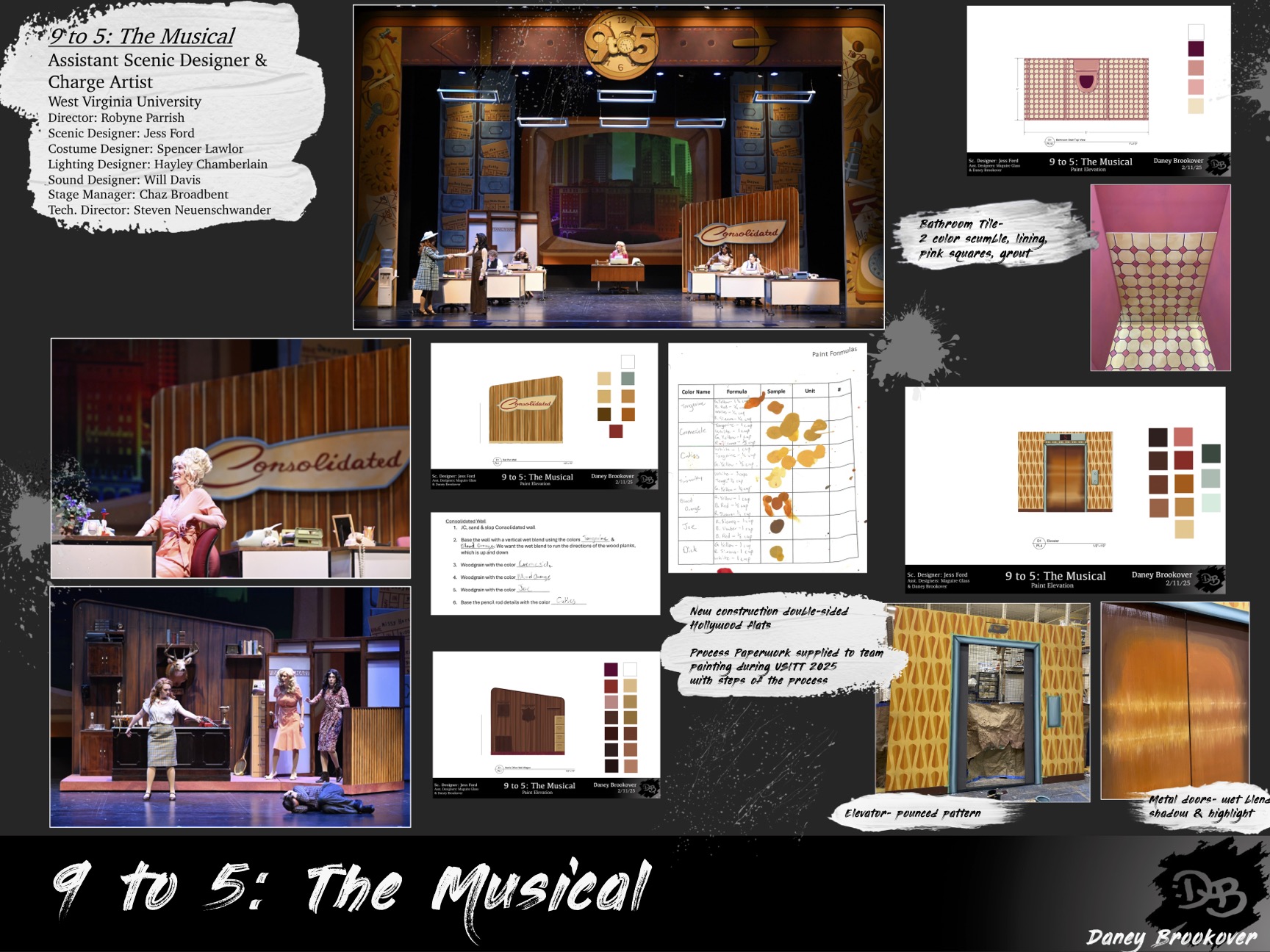
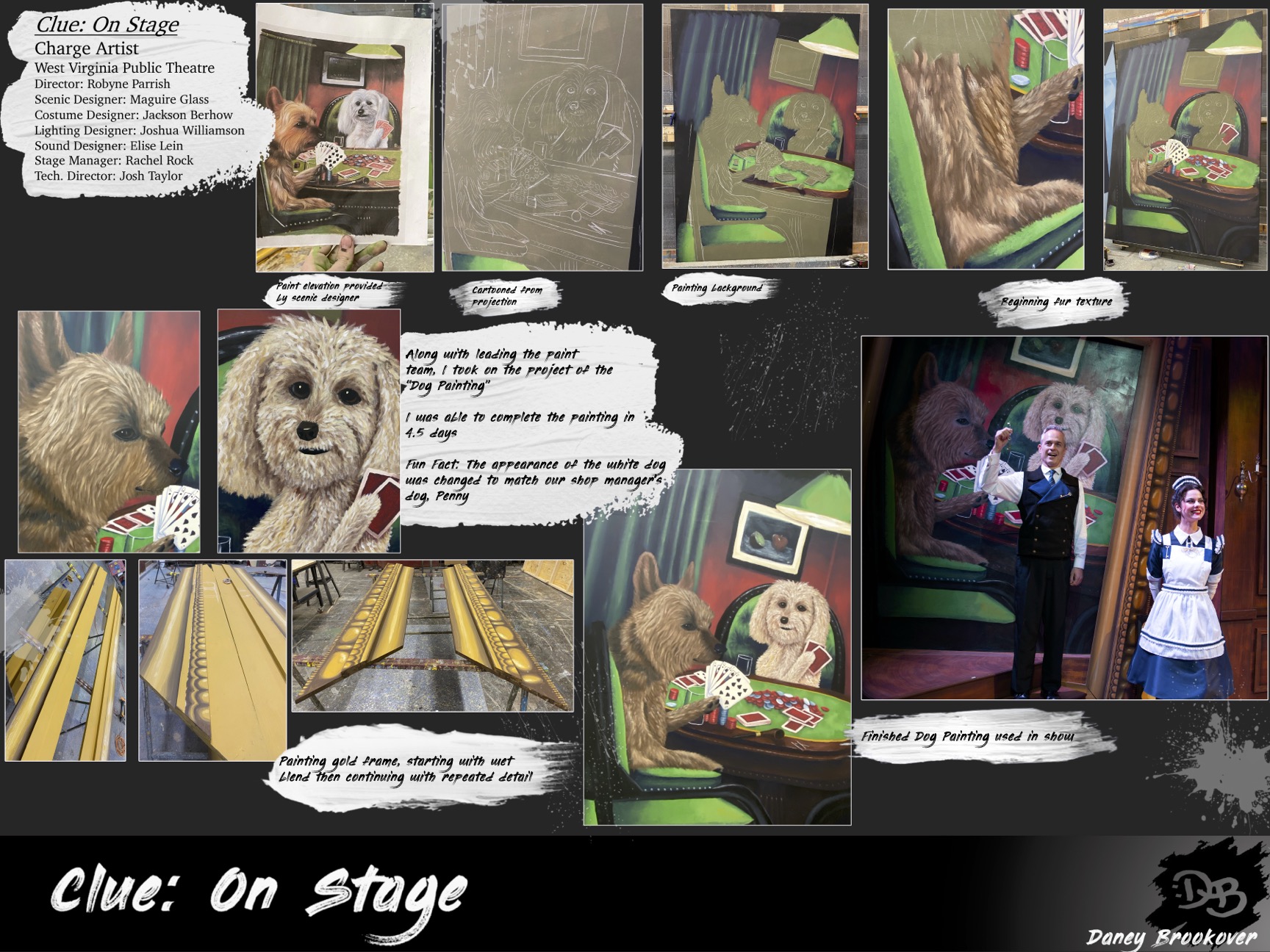
The motivation for my work is to fulfill the desires of the scenic designer by painting true to the paint elevations provided. The style and tone of the show is heavily motivated by the color palette and textures the scenic designer chooses to use. It is important to stay faithful to the designer’s choices.
For every show the designer picks colors that I match to the elevation. A specific green the designer wanted would require me to discover the exact equation of yellow and blue to recreate the color. The next step would be sample boards, a small example of the treatment the designer wants. I create multiple sample boards of different rock treatments, then I take them to the designer to see what got approved and what I should stay away from.
Every show has a different tone and aesthetic that the designer wants to achieve. As a scenic artist, I am happy to take on that responsibility. 9 to 5: The Musical was bright and had a graphic style. Clue: On Stage was mysterious but lighthearted. Christmas Carol was cooler in color and traditional. Every show requires something different, so I am glad to be adaptable.
My work has recently allowed me the privilege of being the recipient of the Bernhard R. Works Master Crafts Award for scenic painting. It was an honor to receive the award next to many other talented creatives from all over the country. I was happy to represent WVU as a theatre technician.
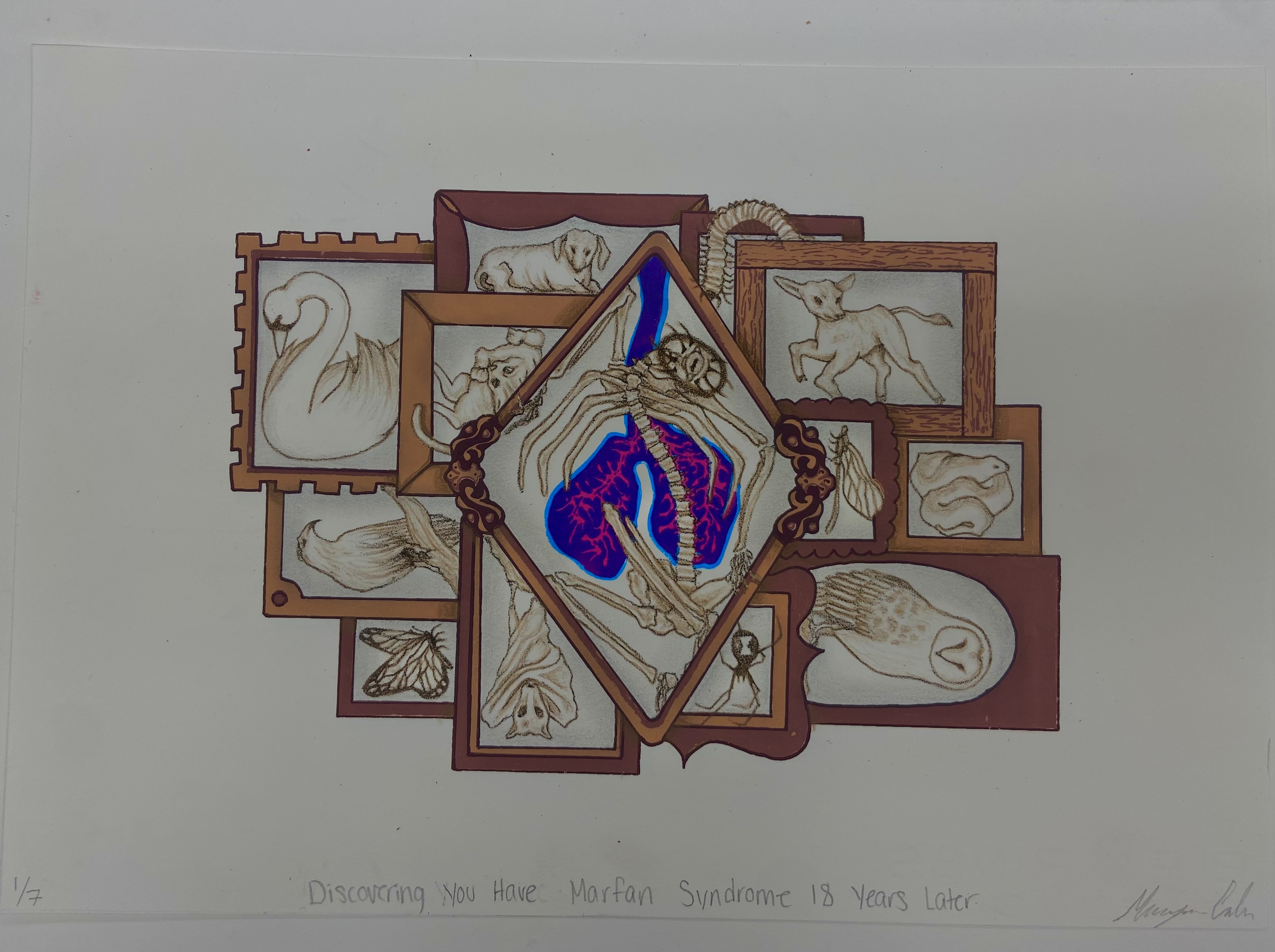
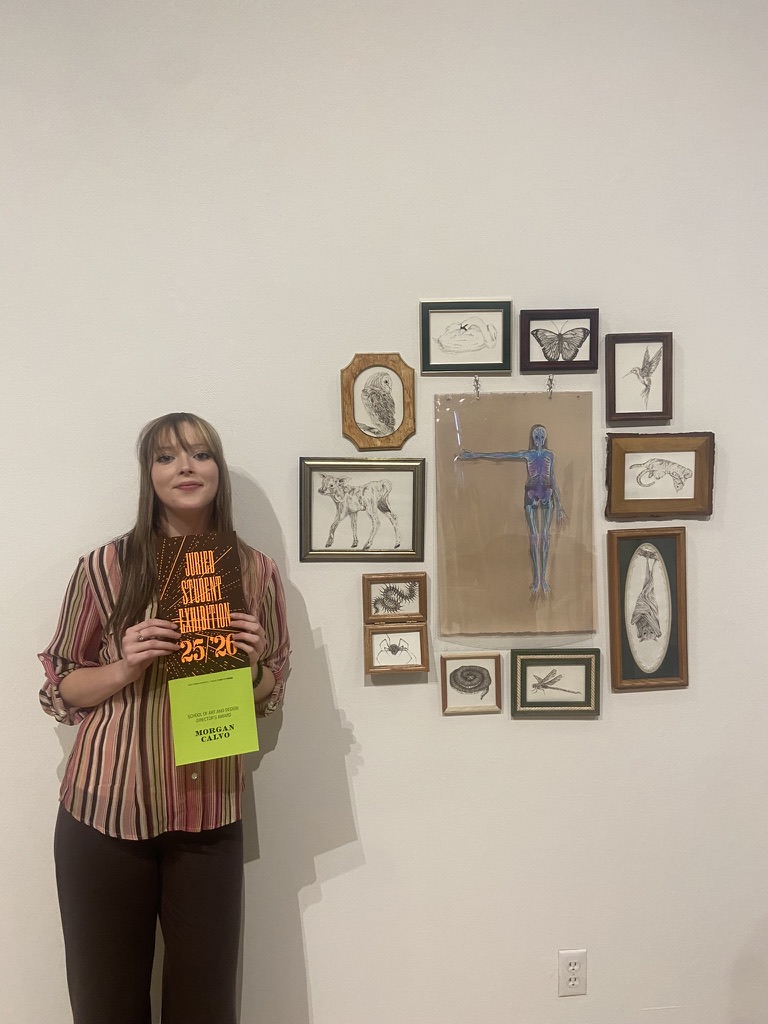
Under Stone, Bone, and Pressure: Marfan Syndrome Through the Lens of Lithography
Undergraduate - Honorable MentionMorgan Calvo
Faculty Mentor: Joseph Lupo
Silkscreen and Lithographic Prints process with a voiceover script.
2024 – 2025
As explained by researchers from Harvard Medical School, Marfan Syndrome is a genetic disorder that distorts one’s proteins that help create one's body's connective tissue, playing a major part in developing properly functioning tendons, ligaments, bones, cartilage, and the walls of large blood vessels. Because of this, your whole body can be affected, and people with this chronic illness experience both mental and physical symptoms. People with this illness can experience sudden death, no matter how young or old, healthy or unhealthy, you may be. Most sudden death cases in people with Marfan Syndrome happen because of a spontaneous aortic aneurysm, where the tissue around the heart is so weak it literally rips itself apart.
Making a body of work about accepting Marfan Syndrome and how it continues to shape my growing female body in a society with unrealistically built expectations for how women should look, live, act, and what they should do in their lives, helps me forget those expectations and feel more content. It is not about being able to fit into female expectations, but to show me and others that you can still be equally as loved and admired by others, and work just as hard, without following the joke that is “the societal female body image”.
Being a relentless and creative person, being an art educator, making art all the time, keeping Lithography alive is what distracts me from that lingering thought of pushed unfair expectations as well as sudden death.
Spatial Audio in Live Theatre
William Davis
Faculty Mentors: Tamara Honesty and Alan McEwen
Performance
September 9, 2025 – March 23, 2026
I often describe myself as a sound engineer first and a designer second. Creating the soundscape for Sueño presented an opportunity to experiment with immersive sound design technology in live theatre. Our concept was to blend traditional sonic elements associated with seventeenth-century Spain, such as Spanish guitar, fanfares, and cannon fire, with modern influences including flamenco interpretations of contemporary music. These ideas helped shape the atmosphere and pacing of the production.
The most significant challenge emerged during the large battle sequence in Act II, which required a dynamic and evolving soundscape capable of conveying chaos, tension, and scale while still functioning within the constraints of live theatre and processing power. This was an opportunity to test the new Audio Object Mapping system, introduced in August 2025 within QLab, developed by Figure 53. This feature allows individual sounds to be treated as movable objects within a virtual map of the performance space, enabling the software to calculate how audio should be distributed across multiple speakers to create the perception of spatial direction and motion.
Combined with randomized playback groups for battle elements such as screams, cannon fire, and environmental sounds, this approach produced an evolving and unpredictable soundscape. Rather than repeating the same sequence of effects each performance, I created variation while reducing the size and complexity of cues within the workspace. The result: a battle sequence that felt chaotic, massive, and immersive, demonstrating how spatial audio tools and randomized variation can expand the creative possibilities of theatrical sound design.
AXiS 46: Beyond the Court
Ella Renshaw
Faculty Mentor: Colleen Moretz
Digital Media
September 30, 2025 – March 4, 2026
AXiS 46 is a mentored creative research project examining how adaptive design can be authentically integrated into contemporary luxury fashion systems. Inspired by the 1946 origins of wheelchair basketball, the project explores how inclusivity can extend beyond accommodation to become a driver of innovation, cultural relevance, and strategic growth.
Through interdisciplinary research spanning brand history, consumer psychology, adaptive sport culture, and market analysis, this work explores how a heritage minimalist brand such as Helmut Lang could enter the adaptive apparel space through a conceptual collaboration with Molten, a company rooted in basketball and wheelchair sport. Rather than designing around trends, the project developed a strategic framework that aligns aesthetic language, functional innovation, and economic viability.
The creative process centered on research-driven design development, translating adaptive design research into detailed flats, construction strategies, and ergonomically considered solutions, including magnetic closures and modular components. Each design decision was evaluated through the lens of user experience, brand integrity, and long-term market positioning.
AXiS 46 illustrates how fashion design can serve as both creative practice and scholarly inquiry, connecting cultural commentary, strategic thinking, and product innovation. The project contributes to broader conversations in creative research by positioning inclusive design as both a creative and industry-wide necessity within the global fashion industry.
Preparing for a Performance: Through the Lens of an Injured Musician
Shairah Sanchez
Faculty Mentor: Mary Grace Johnson
Performance
March 20, 2025
This project involves the exploration of processes and techniques of how one can prepare for a performance while managing an injury. After being selected from a pool of applicants, in March 2025, I had the opportunity to perform in a national masterclass in Atlanta, Georgia, at the American Strings Teachers Association Conference. This great opportunity came with a great deal of preparation, working around a playing injury. With the challenge of being unable to practice my instrument to the fullest, I found ways to learn and prepare away from it. In my research, I determined different ways one can mentally and musically prepare despite the physical limitations. Mental preparation has many components, such as visualization and mental practice, positive goal setting, and setting a routine prior to the performance. Musical preparation includes listening to recordings, score studying, and musical planning. With these techniques, a performer can familiarize themselves with the music on a deeper level, have time to recover, and have a successful performance.
Play In Da Mud: Explorations of Queerness Exhibited Through Appalachian Roots and Fashionable Innovation
James Turner
Faculty Mentors: Angela Uriyo and Colleen Moretz
Fashion Design and Wearable Garments
August 14 – December 17, 2025
“Play In Da Mud” was born out of explorations of my experiences of growing up in both a small city/ big town and cow pasture. Growing up in these environments isn’t exactly the easiest thing, especially as a queer child. Every single silhouette that was developed for this collection took elements from my roots while building it with a bit of modernity. It was important to make something true to my nature and something that would hug the body in a way that uplifts its wearer. The silhouette that I designed was a deliberate stretch to enhance the male form by giving it a large chest and wide shoulders, a pinched waist, and wide, strong legs.
West Virginia is not known as a state of fashion; it is a state of broken industries, deeply rich history, and luscious woods. I chose a neutral palette for this since there is so much that is going on in the form and stayed true to the colors I noticed in my observations as a child. While velvet may seem a little glamorous for West Virginia, the contrast between the rough, distressed denim and the sturdy camo works together in tandem to convey my essence of what Appalachian fashion could be.
Sacred, Secular and the Sounds of Conflict: A Comparative Study of Leonard Bernstein's "Mass" and Benjamin Britten's "War Requiem"
Badyn Woodford
Faculty Mentor: Andrew Kohn
Research Project
Completed: October 2025
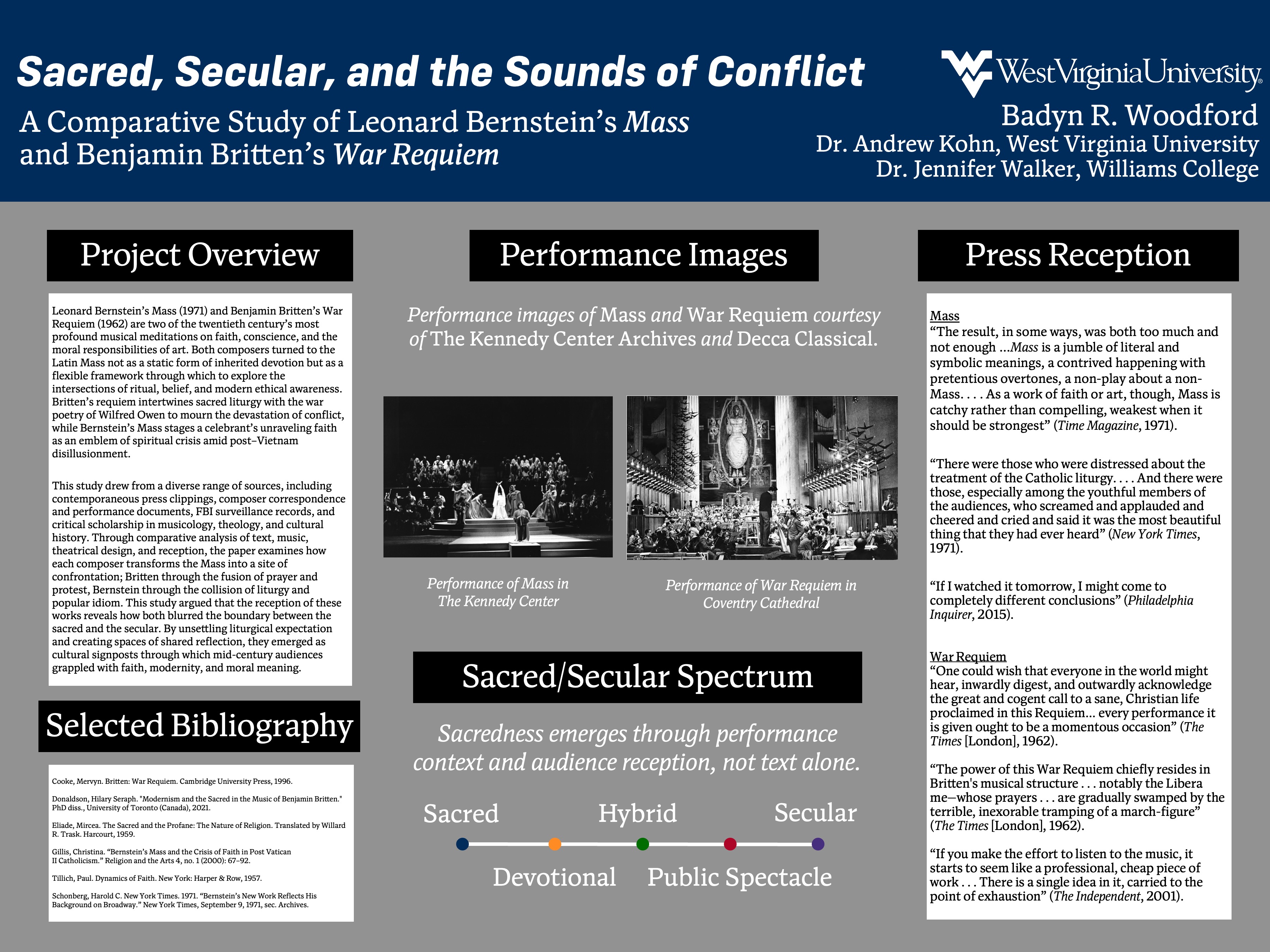
Leonard Bernstein’s Mass (1971) and Benjamin Britten’s War Requiem (1962) are two of the twentieth century’s most profound musical meditations on faith, conscience, and the moral responsibilities of art. Both composers turned to the Latin Mass not as a static form of inherited devotion but as a flexible framework through which to explore the intersections of ritual, belief, and modern ethical awareness. Britten’s requiem intertwines sacred liturgy with the war poetry of Wilfred Owen to mourn the devastation of conflict, while Bernstein’s Mass stages a celebrant’s unraveling faith as an emblem of spiritual crisis amid post–Vietnam disillusionment.
This study draws on a diverse range of sources, including contemporaneous press clippings, composer correspondence and performance documents, FBI surveillance records, and critical scholarship in musicology, theology, and cultural history. Together, these materials situate both works within debates on pacifism, moral authority, and the composers’ capacity to bear witness. Through comparative analysis of text, music, theatrical design, and reception, the paper examines how each composer transforms the Mass into a site of confrontation: Britten through the fusion of prayer and protest, Bernstein through the collision of liturgy and popular idiom. Ultimately, this study argues that the American reception of these works—rooted in pacifist conviction and ecumenical aspiration—reveals how both blurred the boundary between the sacred and the secular. By unsettling liturgical expectation and creating spaces of shared reflection, they emerged as cultural signposts through which mid-century audiences grappled with faith, modernity, and the search for moral meaning.